









Pest problems are something most homeowners deal with at some point, whether it’s ants in the kitchen, rodents in the basement, or termites hidden out of sight. While these issues often feel like one-off household headaches, patterns start to emerge when pest activity is looked at across the country.
The United States is home to drastically different climates, urban environments and housing styles, and these vast differences play a big role in where pests are more likely to thrive. From humid coastal cities to dry desert regions, local conditions play a major role in how easily pests can establish themselves, with some places naturally creating more challenges than others.
To better understand where pest pressure is highest, Excel Pest Services analysed cities and states across the U.S. to identify where homes may be most at risk of pest infestations. By combining population-weighted search behavior with climate data, housing characteristics, and population density, the research reveals where pest problems are most likely to occur in real-world conditions.
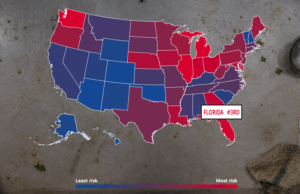
The results revealed clear geographic patterns, with certain cities and states consistently ranking higher due to the conditions they create for pest activity. An interactive map and full rankings allow readers to explore the findings in detail, but several locations stand out immediately.
How the Study Was Conducted
In order to identify the U.S. cities most vulnerable to pest infestations, Excel Pest Service assessed multiple factors that influence both pest activity and the likelihood that infestations will occur and persist once established.
Each city was evaluated across six core indicators:
- Population-weighted search interest for “pest infestation”: This measures how often people search for pest infestation-related terms relative to city size, which allows fair comparison between larger and smaller cities.
- Search trends over the past 12 months: These trends indicate whether concern about pest infestations is increasing or decreasing in each location over time.
- Average annual precipitation: Higher rainfall creates moist environments that pests such as insects and rodents rely on for consistent water availability.
- Average maximum temperature: Warmer climates allow pests to remain active for longer periods, which increases reproduction rates and reduces seasonal population decline.
- Median year homes were built: Older housing stock is more likely to contain ageing materials and structural gaps, which makes it easier for pests to enter and establish themselves.
- Population density: In densely populated cities, pests are able to spread more quickly between properties due to shared walls, plumbing systems, waste infrastructure, and closer living conditions.
Each factor was ranked individually and then combined to produce an overall pest risk ranking for every city included in the study. This approach allows the analysis to reflect where concern is highest as well as where environmental and structural conditions genuinely increase pest vulnerability.
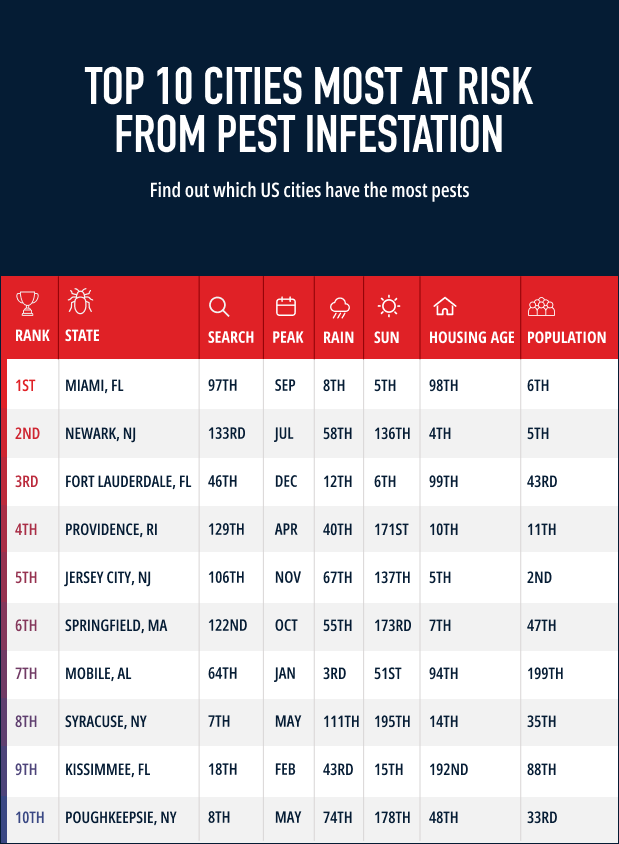
The U.S. Cities Most Likely to Experience Pest Infestations
1. Miami, Florida
Miami is a coastal city known for its warm temperatures and high humidity throughout much of the year. With long, hot summers and frequent rainfall, conditions rarely slow pest activity, allowing insects and rodents to remain active well beyond the typical summer season.
In the study, Miami ranks first overall as the U.S. city most vulnerable to pest infestations. This position is driven largely by climate and urban density rather than search behavior alone. Miami ranks 5th nationally for average maximum temperature and 8th for annual precipitation, creating consistently warm and damp conditions that support year-round pest survival and reproduction. It also ranks 6th for population density, increasing the likelihood that infestations can spread between neighboring properties via shared infrastructure. While the city ranks 98th for housing age, the data suggests climate and density are the dominant risk factors. Search interest peaks in September, aligning with late-summer heat and humidity when pest activity is most visible.
2. Newark, New Jersey
Newark is a densely built urban city with a large proportion of older residential buildings and closely packed neighborhoods.
Ranking second overall, Newark’s position is shaped primarily by structural factors rather than climate. The city ranks 4th nationally for housing age and 5th for population density, indicating that ageing buildings and shared infrastructure significantly increase the likelihood of pest entry and spread. Although Newark ranks much lower for climate-related factors, including 136th for average maximum temperature, warmer months still create periods of increased pest activity. This is reflected in search interest peaking in July. Newark’s ranking demonstrates how dense urban environments and older housing stock can elevate pest risk even without year-round warm conditions.
3. Fort Lauderdale, Florida
Fort Lauderdale is a coastal Florida city characterised by warm temperatures, high humidity, and regular rainfall across much of the year.
Fort Lauderdale ranks third overall, reinforcing the role of climate-driven pest risk in coastal Florida cities. The city ranks 6th for average maximum temperature and 12th for annual precipitation, producing warm, moisture-rich conditions that support pest survival and reproduction throughout much of the year. These environmental factors appear to outweigh other considerations, including housing age, which ranks 99th nationally. Despite ranking lower for population-weighted search interest at 182nd, search interest peaks in December, suggesting pest activity remains a year-round issue rather than a strictly seasonal one.
4. Providence, Rhode Island
Providence is a compact northeastern city with dense residential areas and a high proportion of older housing stock.
Providence’s position in the top five illustrates how structural factors can elevate pest risk even in cooler climates. The city ranks 10th for housing age and 11th for population density, reflecting closely packed and ageing buildings that are more vulnerable to pest entry and internal spread. While Providence ranks much lower for climate-related factors, including 171st for average maximum temperature, these structural conditions play a significant role in shaping overall vulnerability. Search interest peaks in April, which may reflect increased concern as temperatures rise and pest activity resumes after winter.
5. Jersey City, New Jersey
Jersey City is one of the most densely populated cities in the United States, with extensive multi-unit housing and shared infrastructure.
Completing the top five, Jersey City presents one of the clearest examples of density-driven pest risk. Ranking 2nd nationally for population density and 5th for housing age, the city’s tightly packed and older housing infrastructure creates ideal conditions for infestations to spread between properties. Even without extreme heat or rainfall, pests can move efficiently through shared walls, plumbing systems, and waste infrastructure. Search interest peaks in November, suggesting pest concerns extend beyond summer months in cities where infestations are less seasonal and more structurally driven.
The U.S. Cities Least Likely to Experience Pest Infestations
On the other end of the rankings are cities where environmental conditions make survival that much more challenging for pests. Reno, Nevada is a clear example of this finding.
Located in a high-desert region, Reno experiences low annual rainfall and a much drier climate overall. It is the lack of moisture that appears to limit the conditions many pests rely on to survive and reproduce. Colder winter temperatures further slow pest activity for part of the year which reduces the opportunity for populations to continuously grow.
Cities with similar profiles tend to show more balanced scores across the ranking factors, where higher risk in one area is offset by lower risk in others. This balance reduces overall vulnerability, even when individual factors might suggest some level of exposure.
The States Most at Risk Overall
When unpacking the top 20 highest-ranking cities, two states appear most frequently: Florida and New Jersey.
Florida’s prominence in the study reflects its warm, humid climate and high levels of precipitation, which create ideal conditions for year-round pest activity. Cities such as Miami (ranked 1st), Fort Lauderdale (3rd), and Orlando (20th) appear repeatedly near the top of the rankings, highlighting how consistently favorable conditions for pests exist across the state. Many of Florida’s cities also feature dense urban areas and shared infrastructure, which can accelerate the spread of infestations once they occur.
New Jersey’s appearance appears to be driven less by climate and more by structural factors. Older properties combined with high population density in cities such as Newark and Jersey City, increases the likelihood that pests can access properties and persist over time.
Excel Pest Services operates across both Florida and New Jersey, and the findings of this study align closely with the environmental and structural conditions encountered in these regions on a day-to-day basis. The results showcase how pest risk is shaped by a combination of climate, housing, and urban design rather than a single dominant factor.
What Homeowners Can Do to Reduce Pest Risk
While geographic factors influence overall risk, there are steps homeowners can take to reduce the likelihood of infestations, regardless of location.
- Sealing entry points: Cracks, openings, and damaged seals around doors, windows, and foundations provide easy access for pests. Regular inspections and maintenance help reduce these vulnerabilities.
- Managing moisture: Leaks, standing water, and poor drainage create the conditions many pests rely on. Addressing moisture problems early can significantly reduce pest attraction.
- Monitoring early signs: It is important to know the signs in order to address them. Unusual smells, droppings, damage to materials, or increased insect activity usually indicates a developing pest problem. Early intervention is far more effective than reactive treatment.
- Staying aware of seasonal patterns: Understanding when pest activity increases in your area empowers proactive prevention rather than reactive response.
About the Research
This study was conducted using population-weighted search data, climate metrics, housing characteristics, and population density in order to assess pest infestation risk across U.S. cities. The rankings reflect combined scores across all factors rather than reliance on a single indicator.
The full dataset and interactive map allows researchers to explore individual city profiles and compare how different factors contribute to overall pest infestation risk.
Get Expert Help When You Need It
Professional pest activity assessments can help identify risk factors early and prevent infestations from escalating. Excel Pest Services provides pest control and prevention services across Florida and New Jersey, working with the two locations that feature most prominently in this study.